
The Importance of Testing Initiating Devices on Fire Protection Systems
A fire alarm system is only as reliable as its weakest component, and initiating devices are the front line of that reliability. These are the sensors and manual stations that detect an emergency and trigger the notification and suppression systems that protect lives and property.
Initiating devices are also some of the most overlooked elements of routine maintenance. A smoke detector that has quietly failed, or a pull station buried behind stacked inventory provides no warning until the moment it’s needed most. By then, it’s too late to fix. Regular testing isn’t a bureaucratic checkbox. It can be the difference between a fire protection system that saves lives and contains a fire and one that doesn’t.
Why Initiating Device Testing Matters
Initiating devices are exposed to the everyday wear of the buildings they protect. Dust accumulates inside smoke detector chambers. Heat detectors can be affected by nearby equipment or environmental changes. Manual pull stations get painted over, blocked by furniture, or damaged during renovations. None of these issues are visible from a quick walkthrough, and they may only surface during functional testing.
Codes like NFPA 72, the National Fire Alarm and Signaling Code, exist precisely because visual inspection alone cannot confirm a device is working. Testing requirements specify how often each device type must be activated and verified, ensuring that when a fire actually occurs, the system responds as designed. Skipping or delaying these tests doesn’t just risk a failed inspection, it risks a failed response during an actual fire event, when seconds determine outcomes.
There’s also a compliance dimension building owners can’t ignore. Insurance carriers, local fire marshals, and AHJs (Authorities Having Jurisdiction) frequently require documented proof of testing. A building with an untested or improperly maintained fire alarm system can face code violations, increased liability, and even voided insurance coverage in the event of a loss. Routine testing protects not just occupants, but the business itself.
Understanding the Two Categories of Initiating Devices
Initiating devices fall into two categories: automatic and manual. Both play essential, complementary roles in a complete fire protection strategy, but they detect danger in fundamentally different ways. Understanding that difference helps building owners appreciate why both require dedicated testing protocols.
Automatic Initiating Devices
Automatic devices detect a fire condition without human intervention. They rely on sensing technology to identify smoke, heat, flame, or other fire signatures and immediately signal the fire alarm control panel. Common examples include:
- Smoke detectors (photoelectric and ionization types), which sense particles in the air associated with combustion
- Heat detectors, which activate at a fixed temperature or a defined rate of temperature rise
- Flame detectors, used in specialized/extra hazard environments to sense the infrared or ultraviolet signature of open flame
- Waterflow switches, which detect water movement in a sprinkler system, signaling that a sprinkler head has activated
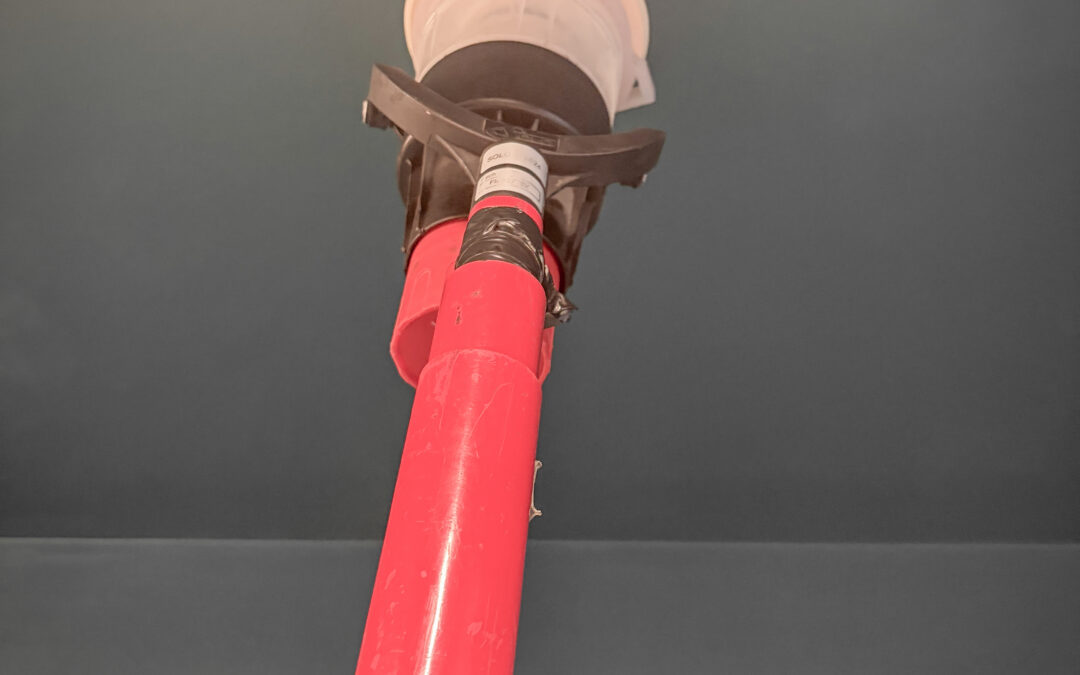
Pictured above is routine testing of a smoke detector.
The strength of automatic devices lies in their speed and consistency. They don’t depend on someone noticing a fire, being physically present, or reacting quickly under stress. In many cases, automatic detection identifies a developing fire condition, like smoldering combustion, long before it would be visible or apparent to a person in the building. This early warning can be the difference between a contained incident and a full structural loss.
However, automatic devices also carry unique testing challenges. Sensitivity drifts over time due to dust, humidity, and component aging. NFPA 72 requires sensitivity testing for smoke detectors at specified intervals precisely because a detector can appear to be functioning (powered, connected, showing no trouble signal) while its actual detection threshold has degraded. Testing verifies not just that the device responds, but that it responds at the correct sensitivity level.
Manual Initiating Devices
Manual devices depend on human action to trigger an alarm. The most familiar example is the manual pull station, or the red box mounted near exits that occupants activate by pulling a lever or breaking a glass rod. Other manual devices include emergency response stations and manually operated fire alarm boxes used in specific applications.
Manual devices serve a different but equally critical function as they empower a person who visually confirms a fire to immediately alert the entire building. This matters in scenarios where a fire starts in a way automatic detection might not catch quickly, such as a visible flame in an open area with high ceilings where smoke takes longer to reach a ceiling-mounted detector.
Testing manual stations is deceptively simple but easy to neglect. Because they have no moving sensor components degrading in the background, it’s tempting to assume a pull station “just works.” In reality, testing confirms the mechanical action functions properly, the signal reaches the control panel without delay, and that the device remains physically accessible and unobstructed. A pull station blocked by stored equipment is effectively useless, regardless of its mechanical condition.
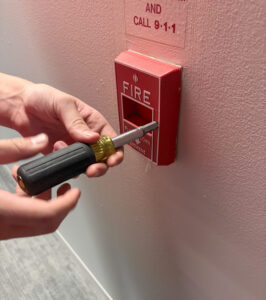
Pictured above is routine testing of a pull station.
Why the Comparison Matters for Building Owners
Neither automatic nor manual devices are a substitute for the other. Automatic devices provide continuous, unattended monitoring and often the earliest possible warning. Manual devices provide a direct, human-triggered failsafe, especially valuable in the moments before automatic sensors would otherwise respond. A well-designed fire alarm system layers both, and a well-maintained system tests both, each on their own distinct schedules and methodologies, as required by code and the AHJ.
Automatic devices need functional and sensitivity testing to confirm they’ll still catch a fire’s earliest signs. Manual devices need physical and accessibility testing to confirm a person can use them without hesitation or obstruction. Treating either as “set and forget” without any reoccurring maintenance creates a blind spot in the system’s overall protection.
Partnering with a Professional Testing Provider
For building owners and managers, testing initiating devices isn’t optional maintenance, it’s a core life-safety obligation. A qualified fire protection contractor understands the specific testing intervals, methods, and documentation requirements for every device type in a system and can identify developing issues before they become failures.
At Independence, routine initiating device testing is built into every service plan, ensuring that both the automatic sensors quietly watching a building and the manual stations waiting for a human hand are ready to perform exactly when they’re needed. A fire alarm system’s value isn’t only in its installation, it’s in its readiness verified test after test.