
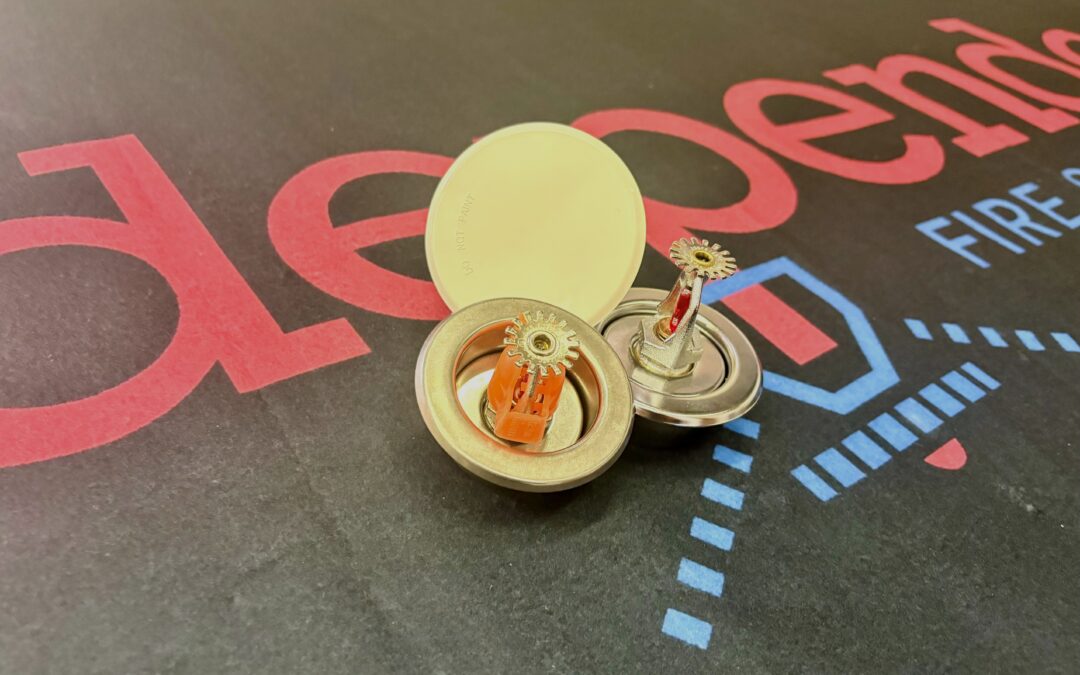
When people think about fire sprinklers, they usually picture water spraying everywhere the moment an alarm goes off. In reality, sprinkler heads are precise, heat-activated safety devices designed to control a fire at its source, often before the fire department even arrives.
In this Sprinkler Heads 101 guide, we’ll break down the different types of sprinkler heads, how they activate, what the color-coded bulbs mean, and the frequencies each type of head should be inspected at. Whether you’re a property manager, building owner, or simply curious about how your fire protection system works, understanding your sprinkler heads is the first step to keeping your building safe and compliant.
CLASSIFICATION
Sprinkler heads are classified by their mounting style and method of activation. The mounting styles include: conventional, upright, pendant, horizontal sidewall, vertical sidewall, recessed, and concealed. Pendants are installed hanging down from the ceiling, so they are typically used when the piping runs above a ceiling. Upright heads are installed on top of the piping, and spray water upward. They are more typically used in buildings with exposed piping and open ceilings. Sidewalls are used when piping cannot be in the ceilings, and as the name suggests, they are mounted on the wall rather than the ceiling. Concealed heads are used to hide a head for aesthetic purposes. The cover over the head will drop upon activation at a set temperature. Lastly, recessed heads are a middle ground between completely concealed and completely uncovered heads – they are only partially visible.
The mechanism of activation aspect of the head gets a little more in depth to the specifics of how the head works. A Fusible-Link sprinkler head has a metal alloy inside that melts at a preset temperature. When the alloy melts, it breaks the link connected to it and releases a cap, which lets out air and alters the air pressure in the system. A Frangible-Bulb sprinkler head contains a glass bulb that breaks at a preset temperature. This also releases a cap that allows the water and air pressure in the system to change. A Chemical-Pellet sprinkler head utilizes a plunger mechanism to hold a cap in place. When heated to a certain temperature, the pellet releases the cap, and once again changes the air pressure that sets off the system. An Early-Suppression or Fast-Response sprinkler head contains larger orifices, which allows for larger amounts of water to be discharged. Lastly, a Deluge sprinkler head has no mechanism of release, as all heads in a deluge system must activate at the same time.
COLOR CODED BULBS
Most modern sprinkler heads have a glass bulb, with a color that attributes to different temperatures of activation. A red-colored liquid inside the bulb means the head will activate at the lowest set temperature, 155 degrees Fahrenheit. A yellow liquid inside the bulb means it will activate at 175 degrees, a green liquid at 200 degrees, and a blue liquid at 286 degrees. Glass bulbs with a blue liquid are more common in areas that typically reach higher temperatures, such as in boiler rooms or manufacturing plants, so the system doesn’t accidentally activate.
TESTING FREQUENCY
Sprinkler heads are tested in representative samples. According to NFPA 25, the sample must be at least 1% of the total number of sprinklers in the area being tested. If 1% of the sample does not exceed 3 sprinklers, then 4 should be tested. If one head in the representative sample fails the test, then all the heads must be replaced. The interval in which samples are tested depends on a few different factors, including the environment they are installed in, the amount of years they have been in service, and any special elements they contain. For example, dry-type sprinkler heads must be tested once they have been in service for 10 years. If they pass that first 10 year test, then new samples must continue to be tested at 10-year intervals. Heads that are preset at extra high temperatures or subjected to harsh environments must be tested at 5 year intervals. Finally, heads with fast response elements must be tested at 20 years. Building owners also have the option to completely replace heads rather than go through the testing process if they so choose.
To learn more, or to get the sprinkler heads in your building tested, visit us at https://indpfire.com or give us a call at +1 (484) 494-7724.